THE SHORT ANSWER
The key idea, first.
A water vortex is a region of water circulating around an axis. Rotation can produce a depressed surface or an air-filled funnel, although not every vortex has a visible hollow core. Draining bottle models combine an initial spin with gravity; circulating museum displays can maintain rotation differently. Similar shapes do not establish identical mechanisms.
- Recognize rotation and a surface funnel as different observations.
- Explain how angular momentum helps describe inward-moving water under stated assumptions.
- Compare a draining bottle with an exhibit without assuming identical plumbing or controls.
WATCH & NOTICE
Look closely at the demonstration.
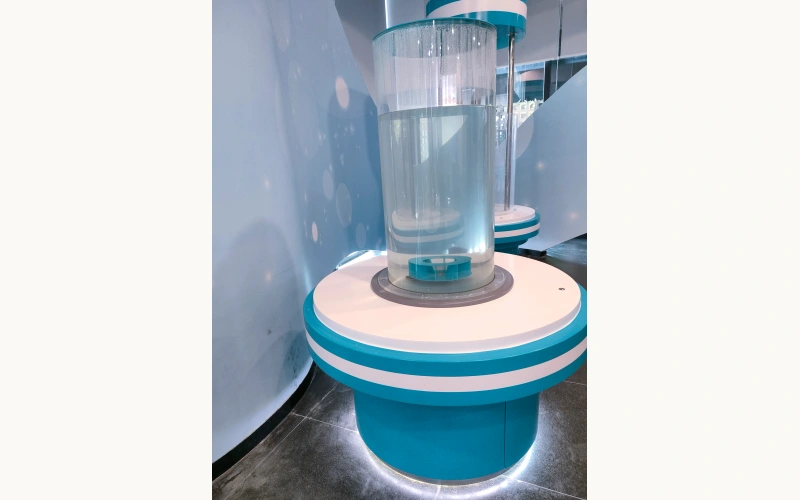
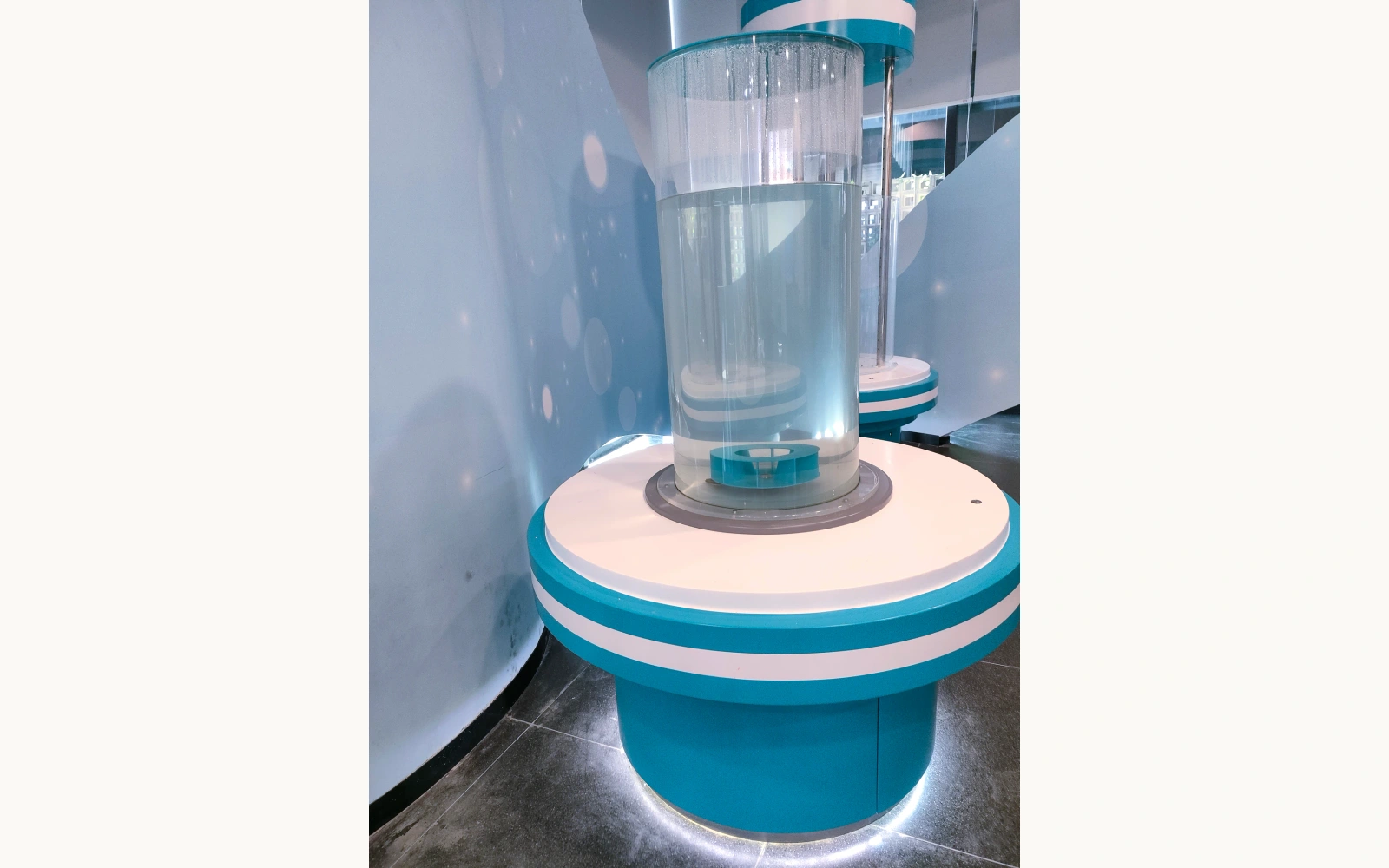
The physical reference video shows a transparent water cylinder. Practice careful observation before interpreting its flow.
Find the surface
Locate the water–air boundary. Look for shape changes; colored illumination is not a flow measurement.
Choose visible evidence
Look for a traceable bubble or surface feature. Note when motion cannot be followed reliably.
Check the core
Look for a continuous air funnel and distinguish it from reflections on the cylinder wall.
About this video reference
The short recording shows the vessel and changing illumination without a clearly resolved air funnel or measurable water trajectory. The recording does not verify internal circulation, control settings or flow speed.
01 / EXPLAINING THE IDEA
Start with the water, not the word tornado
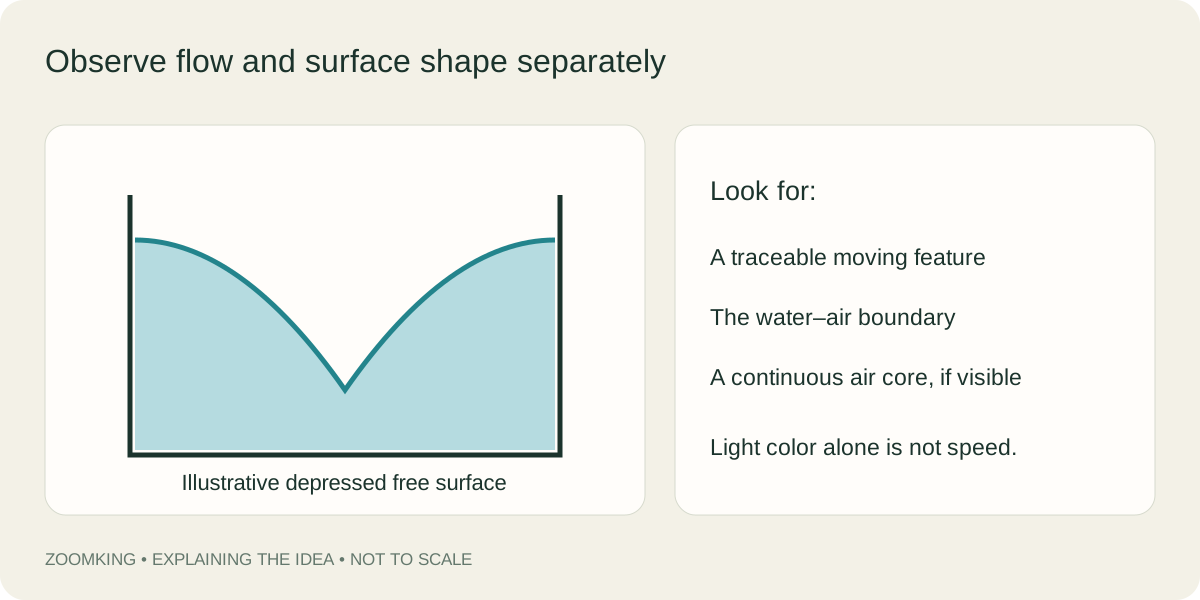
Begin at the cylinder's water surface. Sketch its outline and mark the apparent center. Then ask what visible feature would show water moving around an axis. A reflection alone cannot answer that question. Give the sketch a viewing-direction label so another observer can compare it with the vessel.
In the video below, the lighting changes conspicuously. That makes an attractive display, but color is not a speed indicator unless the relationship has been established separately. Keep two columns in a notebook: directly visible features and proposed explanations. An entry such as 'a blue glow appeared' belongs in the first column; 'the pump accelerated' would need additional evidence.
02 / EXPLAINING THE IDEA
A funnel is a surface shape within a rotating flow
Water circulating around a central axis can develop a depressed central surface. A deep depression may expose an air core. This is why a whirlpool can look like a hollow funnel: the visible boundary separates air from the surrounding water. The shape and the moving liquid are related, but they are not the same thing.[1]
The Exploratorium describes a museum vortex maintained by withdrawing water below and returning it near the top so that it spins. Its explanation connects the funnel shape with water pressure and depth. That is a useful example of a circulating exhibit, not proof that another cylinder has the same pipework. A product name or similar silhouette cannot establish hidden construction.[1]
03 / EXPLAINING THE IDEA
Moving inward can change the rotation rate
Angular momentum describes rotational motion about a chosen axis. When the net external torque is negligible, a system retains its total angular momentum. A spinning skater who draws their limbs inward provides a familiar example: reducing rotational inertia increases angular speed. Water moving inward can illustrate a related concentration of rotational motion.[2]
The analogy needs boundaries. Water is deformable, exchanges momentum between regions, and interacts with vessel walls and any driving mechanism. Do not apply a whole-body skater equation to every point in a real vortex. Use conservation as a starting model, then ask which torques, inflows and outflows would have to be included in a measured explanation.[2]
04 / EXPLAINING THE IDEA
A draining bottle makes the air path important
In NOAA's two-bottle demonstration, water leaving the upper bottle must make room for air moving upward. Without an established vortex, bubbles and water compete at the narrow connection. After the water is given a horizontal swirl, an air passage can develop through the center while water drains around it. The bottle can then empty more smoothly.[3]
This example combines gravity-driven drainage with a spin supplied by the demonstrator. It does not reproduce every atmospheric process that creates a tornado. It also differs from a display that recirculates water without visibly emptying its vessel. Comparing where water and air enter and leave is more informative than deciding that two funnels must be miniature copies of the same event.[3]
05 / EXPLAINING THE IDEA
Change one condition in a classroom model
The University of Wisconsin–Madison's vortex-bottle activity suggests exploring initial spin, the opening and bottle tilt. Choose one of these questions at a time. For an initial-spin comparison, keep the same connector, fill level and upright position, and use a teacher-prepared, securely joined plastic-bottle assembly over a tray. Compare a gentle start with a stronger one.[4]
Before either trial, decide what to record: whether a continuous air path appears, whether flow pauses, or how long a chosen water-level change takes. Repeat each condition rather than choosing the most impressive run. Calling the start 'gentle' is only a qualitative description; it does not establish a known initial angular speed. Record that limitation alongside the result.
06 / EXPLAINING THE IDEA
Make the final explanation match the evidence
Complete three sentences: we observed this feature; our model suggests this explanation; we need this extra measurement to check it. A drawing can describe surface shape. Identifiable tracers could reveal rotation. Neither alone supplies a pressure map or proves the internal route through a cabinet.
Return to the video and list unresolved questions. Where is the driving input? Is the vessel draining or recirculating? What feature can be followed consistently? Use these questions in a facilitated visit or exhibit brief, keeping uncertainties visible alongside the explanation.
Common questions.
Is a water vortex the same as a tornado?
Both involve rotation in a fluid, but a bottle's spin and drainage do not reproduce the atmospheric processes that generate a tornado.[3]
Can a bottle vortex turn either way?
Yes. NOAA's model can be started in either direction. State the viewing direction when describing clockwise or counterclockwise motion.[3]
Does the exhibit video measure vortex speed?
No. The sampled frames establish a physical cylinder and changing illumination, not a calibrated trajectory, pressure distribution or rotation rate.
SCIENCE & FURTHER READING
Follow the sources.
Read the original scientific explanations and teaching resources behind this article.
- Exploratorium: Vortex exhibit reference
A documented circulating museum vortex and its surface shape. Its pumping arrangement is not assigned to Exhibit Engineers's cylinder.
- OpenStax University Physics: Conservation of Angular Momentum
Conservation under negligible external torque and the changing-inertia analogy; not a full fluid-flow model.
- NOAA: Tornado in a Bottle
Bottle drainage, air return, initial spin and limitations of comparison with an atmospheric tornado.
- University of Wisconsin–Madison: A Vortex Bottle
Classroom exploration of spin, connector opening and tilt. No universal inside/outside speed profile is inferred from its simplified wording.
Editorial: Exhibit Engineers science & exhibit team. Scientific references are cited for the explanations; product configuration details follow the linked exhibit records.