THE SHORT ANSWER
The key idea, first.
Human body systems are cooperating groups of organs, often organized into eleven systems for introductory study. Teaching groupings vary, and organs can contribute to several systems. The Wenzhou gallery's eight grouped topics describe an exhibit arrangement rather than a universal anatomical count.
- Distinguish a cell, tissue, organ and organ system.
- Connect organ structures with functions and exchanges between systems.
- Read a grouped museum display without mistaking its station count for an anatomical rule.
WATCH & NOTICE
Look closely at the demonstration.
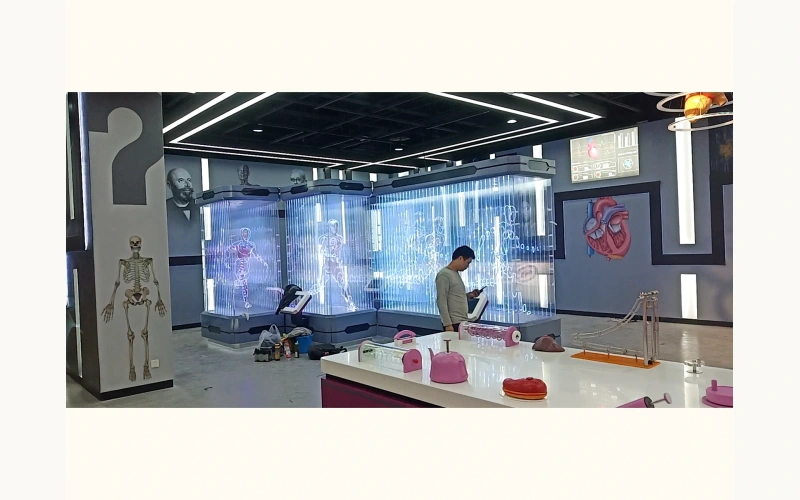
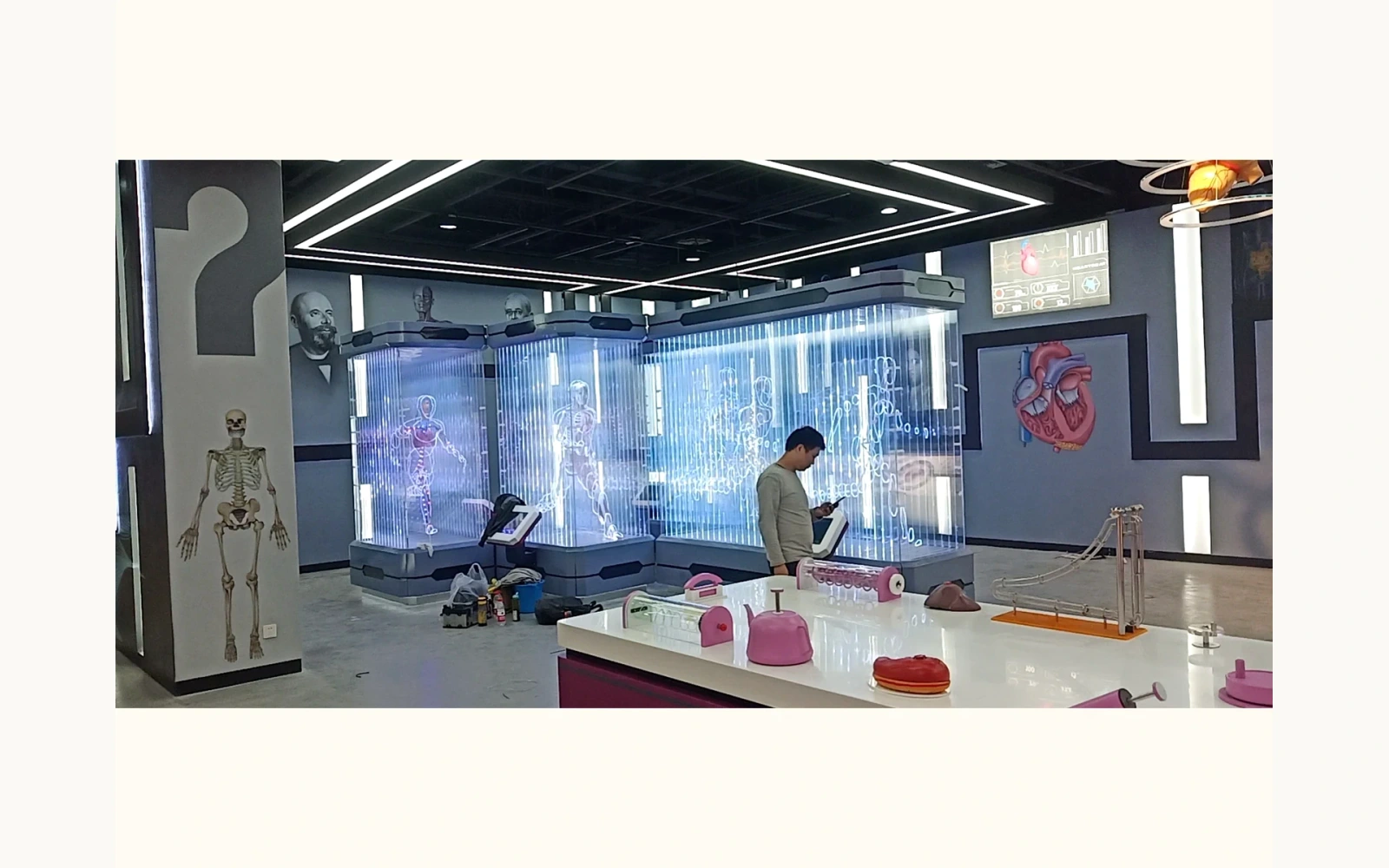
The Wenzhou recording moves among transparent anatomy stations, body outlines and nearby screens. Plan an observation route through the group.
Locate an organ
Choose a visible structure and describe its position within the body outline.
Compare the stations
Notice the different anatomical topics presented in the gallery.
Separate image from explanation
Find the nearby screen. Which functional questions does the anatomy image leave unanswered?
About this video reference
The short silent edit shows the installed group and selected views. It does not verify every touchscreen lesson, software function, anatomical label or visitor interaction. Eight grouped display topics are not an exhaustive count of human organ systems.
01 / EXPLAINING THE IDEA
Begin with the difference between an organ and a system
A cell is a small living unit. Tissues organize cells and supporting material; organs combine several tissue types into structures with particular functions. A body system brings organs into a broader functional relationship. NCI's SEER training introduction uses the stomach to illustrate this: its organization includes muscle, connective, epithelial and nervous tissues.[1]
Ask learners to place four cards in a sequence: cell, tissue, organ and system. Add a second question to prevent the sequence becoming a list of names: what changes when we move from one level to another? A stomach drawing shows an organ's outline, but its tissues explain aspects of how it works. The system view asks how that organ participates with others.
02 / EXPLAINING THE IDEA
Eleven systems is a useful teaching framework
OpenStax organizes introductory anatomy into eleven organ systems and emphasizes that organs can contribute to more than one. The table gives a compact route through that framework. Treat each function as an introduction, not a complete account. The categories help organize study; their boundaries do not divide the body into independent machines.[2]
NCI's introduction lists ten major systems in its own teaching outline. A difference in count calls for checking which categories are included. State the framework before asking learners to count or compare systems; the number alone does not explain their relationships.[1]
| System | One starting function |
|---|---|
| Integumentary | Protective body covering |
| Skeletal | Support and protection |
| Muscular | Movement |
| Nervous | Rapid signaling and coordination |
| Endocrine | Hormonal regulation |
| Cardiovascular | Transport in blood |
| Lymphatic / immune | Fluid return and defense |
| Respiratory | Gas exchange |
| Digestive | Food processing and absorption |
| Urinary | Waste removal and fluid regulation |
| Reproductive | Production of offspring |
03 / EXPLAINING THE IDEA
Follow digestion across system boundaries
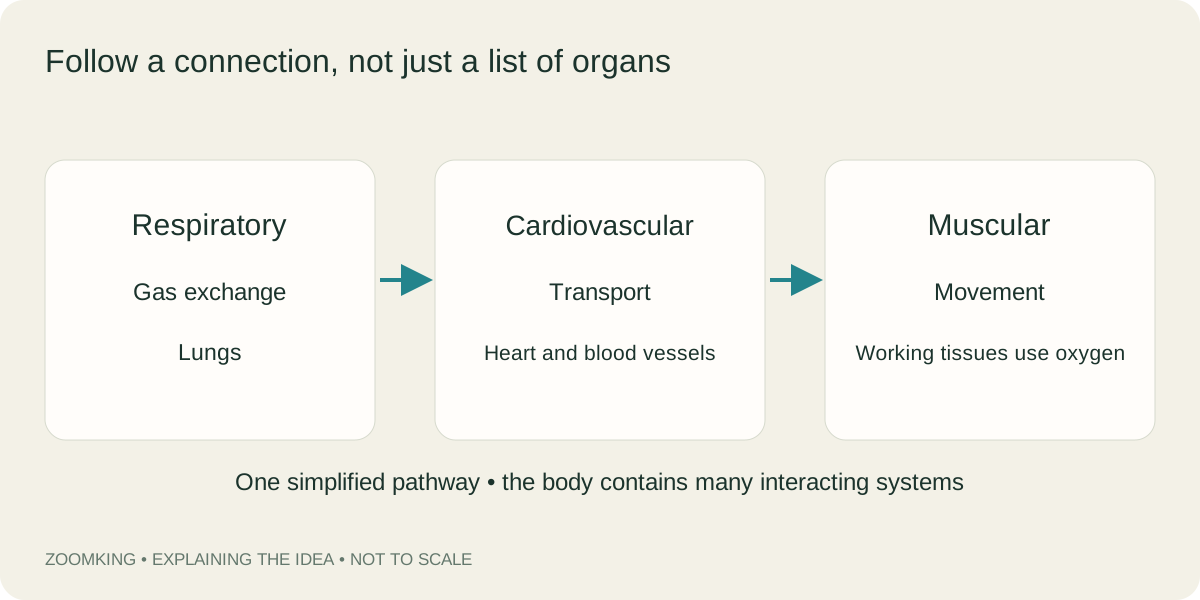
Digestion provides a concrete example of cooperation. The digestive tract moves and breaks down food, while accessory organs supply substances that aid the process. Most nutrient absorption occurs in the small intestine. Absorbed materials then require transport: blood carries many nutrients, while the lymphatic system absorbs dietary fats and some vitamins. The process continues beyond the outline of the gut.[3]
NIDDK also describes nerves and hormones that help control digestion. Muscular movement through the tract, chemical breakdown, absorption and regulation are different parts of one account. On a diagram, use different arrows for material moving through the gut, nutrients entering transport pathways and signals influencing activity. This is an explanatory drawing, not a literal map of every molecule or nerve.[3]
04 / EXPLAINING THE IDEA
Coordination helps regulate internal conditions
Homeostasis means maintaining internal conditions within workable ranges through ongoing regulation. A common mechanism is negative feedback: a detected change prompts a response that opposes that change. OpenStax describes sensors, control centers and effectors as a way of organizing this explanation. Stable regulation involves activity; it does not require every physiological quantity to remain perfectly constant.[4]
Body-temperature regulation gives a useful example. Increased skin blood flow and sweating can contribute to heat loss when the body is too warm. Trace the explanation from a detected condition to a response and then its effect. A thermostat is a limited analogy for this loop, not a suggestion that a human body has one simple household control switch.[4]
05 / EXPLAINING THE IDEA
Read the Wenzhou stations as grouped learning topics
The Wenzhou installation presents eight grouped topics. Its documented material includes skeletal and muscular, digestive and urinary, and nervous and endocrine pairings. These combinations show why an exhibit group should not supply a universal organ-system count. They describe the organization of this particular gallery. Compare the topics with a textbook's categories before deciding what each station covers.
The video shows transparent anatomical imagery with screens beside the stations. That arrangement supports an observation prompt: identify one structure, then name the functional question you would take to the associated explanation. It does not establish that any particular animation, quiz or diagnostic feature is available. Keep the visible installation and the unverified software content separate in a lesson plan.
06 / EXPLAINING THE IDEA
Build a route from a question to a connection
Give pairs a route card with three spaces: structure, function and connection. Record an organ they can locate, a function supported by the reviewed explanation, and another relevant system. Mark answers drawn from accompanying text rather than the anatomy image itself.
After two stations, compare cards and draw a connection. Explain the arrow: an unlabeled line can hide uncertainty. End with a question to check in a reliable anatomy reference. This general science activity does not suggest that a display can diagnose a condition or determine personal treatment.
Common questions.
Are there eight or eleven human body systems?
Eleven is a common introductory framework. Resources can group topics differently; the local eight-topic gallery is a display arrangement, not a universal anatomical count.[2][1]
Can one organ belong to more than one system?
Yes. Organ-system categories overlap in function. The body works through cooperation rather than a set of fully independent compartments.[2]
Is homeostasis the same as staying completely unchanged?
No. Regulation responds to changing conditions and helps maintain workable ranges. Negative feedback is one important mechanism.[4]
SCIENCE & FURTHER READING
Follow the sources.
Read the original scientific explanations and teaching resources behind this article.
- NIH National Cancer Institute: Introduction to the Human Body
Cells, tissues, organs and systems; its ten-system teaching outline illustrates why category counts need context.
- OpenStax Anatomy and Physiology 2e: Structural Organization of the Human Body
Eleven-system framework, introductory functions and overlapping contributions of organs.
- NIH NIDDK: Your Digestive System & How it Works
Movement, digestion, absorption, transport and nerve/hormone control used for a general educational example.
- OpenStax Anatomy and Physiology 2e: Homeostasis
Dynamic regulation, negative feedback and the sensor–control–effector model; no diagnostic or treatment guidance.
Editorial: Exhibit Engineers science & exhibit team. Scientific references are cited for the explanations; product configuration details follow the linked exhibit records.