THE SHORT ANSWER
The key idea, first.
Kinetic sculpture is three-dimensional art in which movement contributes to the experience. Motion can come from electric motors, air currents or a visitor turning a handle. Looking closely reveals changing shapes, repeated actions and relationships between parts. A video can show those movements, but it does not necessarily reveal the energy source, internal transmission or engineering details of the work.
- Recognize movement as an artistic material that unfolds over time.
- Distinguish an observed motion from a proposed explanation of its mechanism.
- Plan a short activity that connects an energy input with a visible change.
WATCH & NOTICE
Look closely at the demonstration.
Watch the 30-second gallery and workshop record twice: first for the whole figure, then for one moving part.
Follow the whole figure
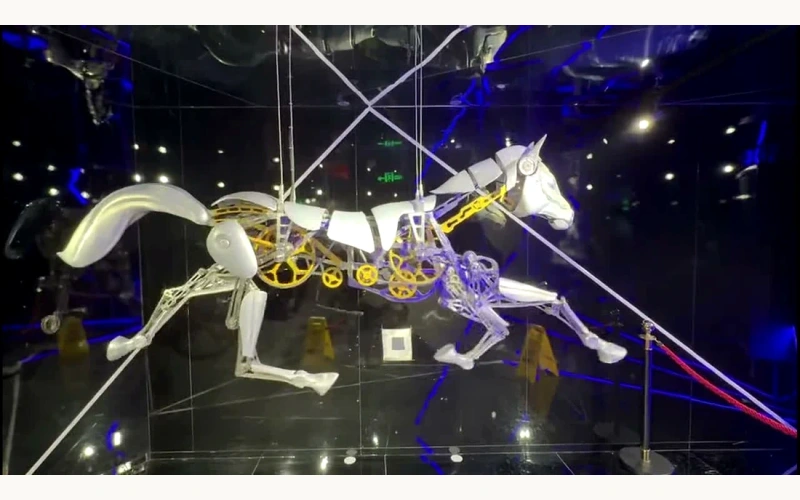
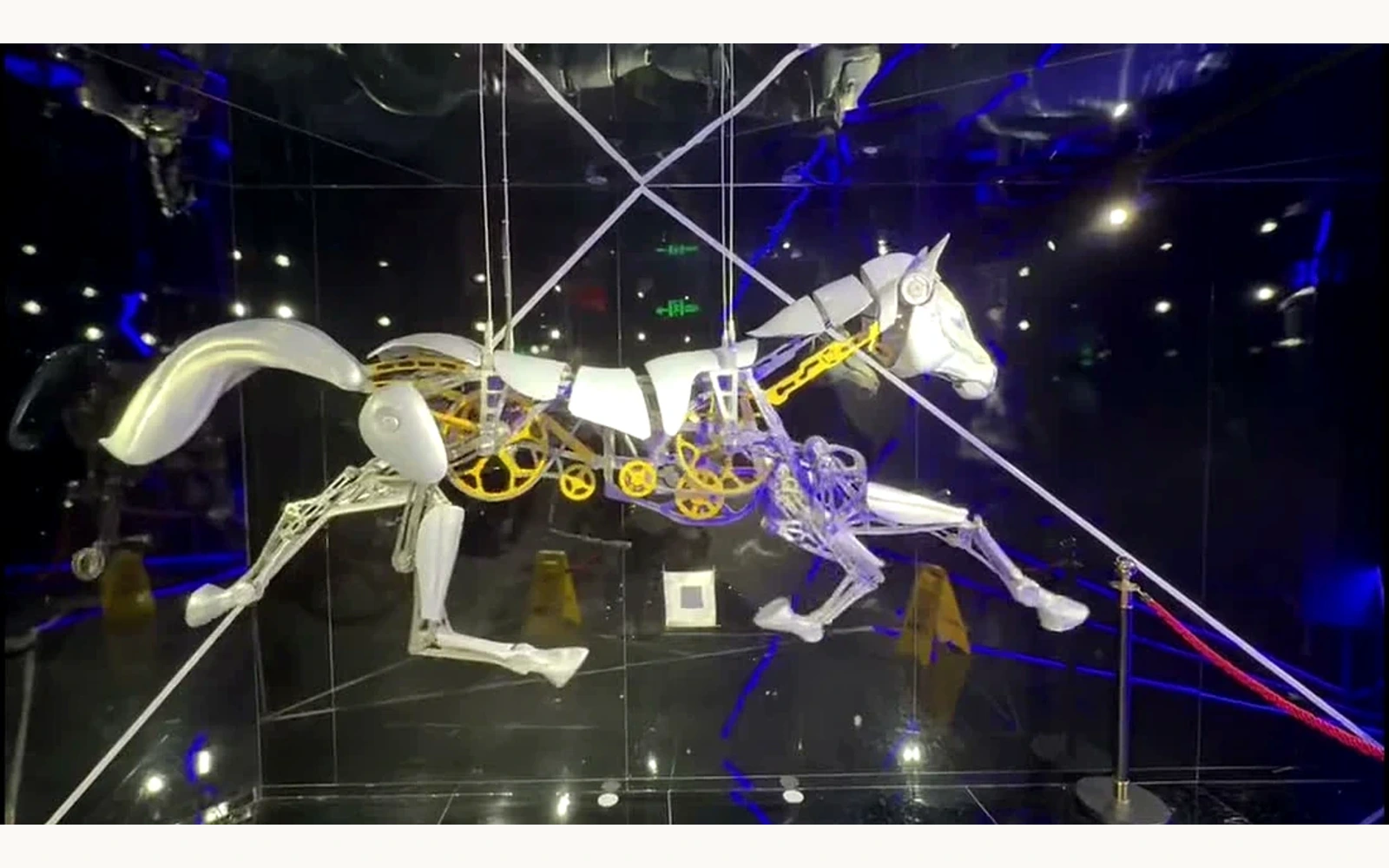
In the gallery view, follow the coordinated movement of the head, tail and articulated legs.
Compare the workshop view
Notice how the change of setting makes the moving physical structure easier to distinguish from the display surroundings.
Return to the gallery
Compare the returning gallery view with your first impression. Identify one motion you overlooked initially.
About this video reference
The record establishes visible movement in two settings. It does not establish the internal drive arrangement, a measured gait, continuous-duty performance or safety certification.
01 / EXPLAINING THE IDEA
Movement is part of the artwork
Begin with what changes while you watch. A leg swings, a hanging shape turns or a surface repeatedly opens and closes. The work has a sequence as well as a shape. MoMA defines kinetic art around motion and identifies motors and air currents as possible ways of producing it.
A useful first question is therefore: what would disappear if this work stopped moving? For a horse sculpture, the recognizable animal would remain, but the relationship between its poses would be lost. That question invites an artistic response before introducing mechanical vocabulary.[1]
02 / EXPLAINING THE IDEA
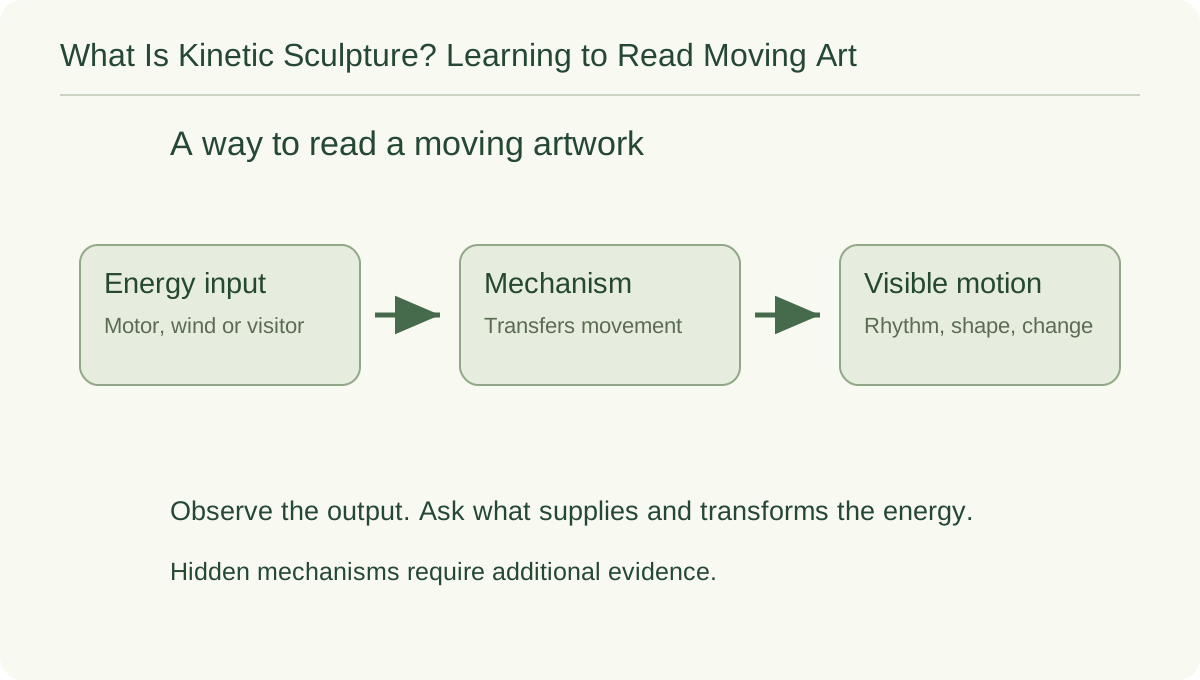
Ask what supplies the movement
Kinetic works need an energy input, although electricity is only one possibility. SFMOMA describes Calder mobiles whose balanced elements respond to passing air currents. The Exploratorium offers another example: small automata activated by a person turning a handle. These works place different demands on the visitor, from waiting for a breeze to actively producing motion.
Invite learners to draw an input arrow beside a sketch: electrical supply, moving air or human action. If the input is hidden, label it unknown. An honest question mark is more useful than assuming that every sculpture with articulated legs has the same motor or transmission.[2][3]
03 / EXPLAINING THE IDEA
Read the horse as a sequence
The accompanying horse video moves from a gallery demonstration to a workshop view and back again. It offers two contexts for reading the same moving subject. Focus on the leg nearest the camera and name three successive positions. Then repeat the exercise with the head or tail. Describe direction and relative timing rather than assigning a biological gait.
A class can compare sketches made at different moments. Ask which features remain recognizable and which change. These observations support a discussion of coordinated motion without requiring a claim about the concealed parts that create it.
04 / EXPLAINING THE IDEA
Separate the motion from the mechanism
An output is the movement you see; a mechanism is an arrangement that produces or transfers movement. The Exploratorium's Cranky Contraptions demonstrates one specific arrangement: a rotating crankshaft, a connector and a guide can produce an up-and-down output. That example helps explain how rotation can become a different kind of motion.
It is a teaching comparison, not an identification of the horse's internal mechanism. Two sculptures can have similar visible movements and different construction. Ask students to propose two possible explanations, then list the extra evidence needed to choose between them, such as a drawing or an unobstructed mechanism view.[3]
05 / EXPLAINING THE IDEA
Compare a horse, a jellyfish and a bird
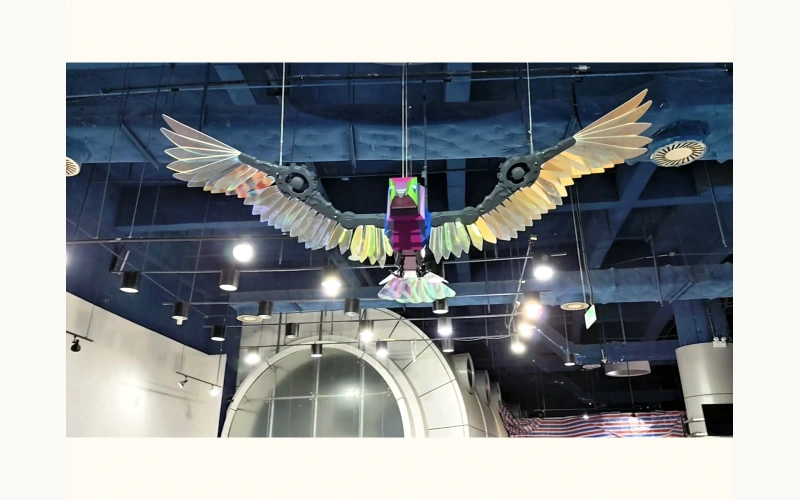
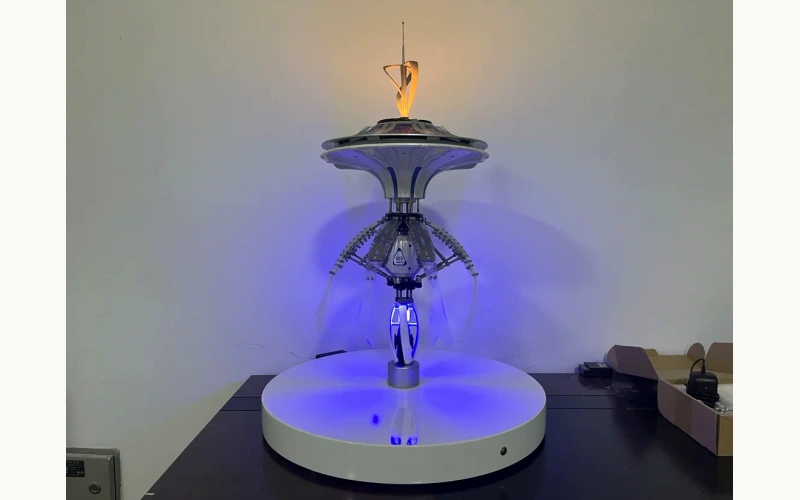
The related local product references offer three useful subjects. The horse emphasizes coordinated body parts. The kinetic jellyfish reference describes an exposed linkage and repeated motion. The suspended mechanical bird emphasizes changing wing positions. Compare their visible outputs rather than treating an animal-inspired appearance as proof of biological accuracy.
Give each group the same observation task: sketch the moving outline, mark one joint or connection that is visible, and describe a repeated action. Their answers can remain different. A sculpture may borrow a recognizable gesture from nature while pursuing an artistic rhythm of its own.
06 / EXPLAINING THE IDEA
Build an observation-to-design activity
Start with an accessible question: which part do you notice first? Ask each learner to predict its next position, watch again and revise the prediction. Follow with a simple hand-operated model inspired by the Exploratorium approach. Choose one desired output before decorating the figure, so learners can tell whether their mechanism achieves the motion they intended.
Invite a second version that changes one feature. Learners can compare a taller lift, a different moving shape or a changed handle pace, while explaining what they altered. Keep records as sketches and descriptions; numerical precision is unnecessary when no measurement procedure has been established.[3]
07 / EXPLAINING THE IDEA
Make the interpretation as clear as the movement
For a museum display, write a short prompt that visitors can answer from their viewing position. Place a simple movement sketch nearby and allow enough time to notice a repeated sequence. Provide still images or a written description for visitors who cannot comfortably follow continuous motion. These are proposed interpretation choices, not claims about an existing installation.
An exhibit brief should identify the intended visitor action, the viewing area and the movement to discuss. Request separate technical information for operation and maintenance. The educational goal is straightforward: visitors leave able to describe a change, explain what evidence they used and recognize what remains unknown.
Common questions.
Does a kinetic sculpture need an electric motor?
No. Motors are one possible input; passing air currents or a person turning a handle can also produce movement. The energy source should be identified from reliable information about the particular work.
Is every kinetic sculpture interactive?
No. A moving sculpture can be watched without visitor control. A hand-operated automaton adds a direct connection between a participant's action and the resulting motion.
Does the horse video show how every joint is driven?
No. It shows coordinated external movement in gallery and workshop settings. Establishing the internal drive arrangement would require additional evidence from the maker.
SCIENCE & FURTHER READING
Follow the sources.
Read the original scientific explanations and teaching resources behind this article.
- MoMA — Kinetic art
Museum definition of kinetic art and motor-driven or air-responsive motion.
- SFMOMA — Alexander Calder
Museum account of balanced mobile elements responding to passing air currents.
- Exploratorium — Cranky Contraptions
A hand-operated automaton and an accessible example of crank-slider motion; not evidence of the horse's internal design.
Editorial: Exhibit Engineers science & exhibit team. Scientific references are cited for the explanations; product configuration details follow the linked exhibit records.