THE SHORT ANSWER
The key idea, first.
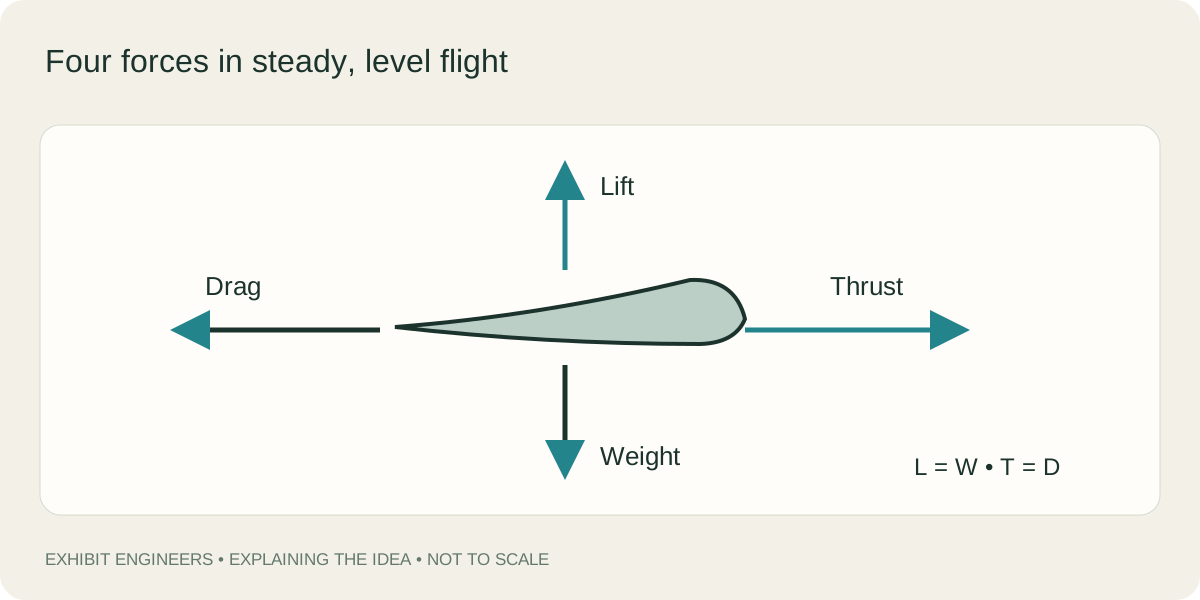
Airplane wings generate lift as air flows around them. Pressure distributed over the wing produces a net aerodynamic force, while the surrounding airflow gains downward momentum. These are compatible descriptions of the same interaction. Engines usually supply thrust to overcome drag and sustain airspeed; in steady, straight, level flight, lift approximately balances weight.
- Connect pressure forces on a wing with changes in the air's momentum.
- Reject the claim that air parcels must reunite behind a wing.
- Distinguish qualitative exhibit observations from measured aerodynamic performance.
WATCH & NOTICE
Look closely at the demonstration.
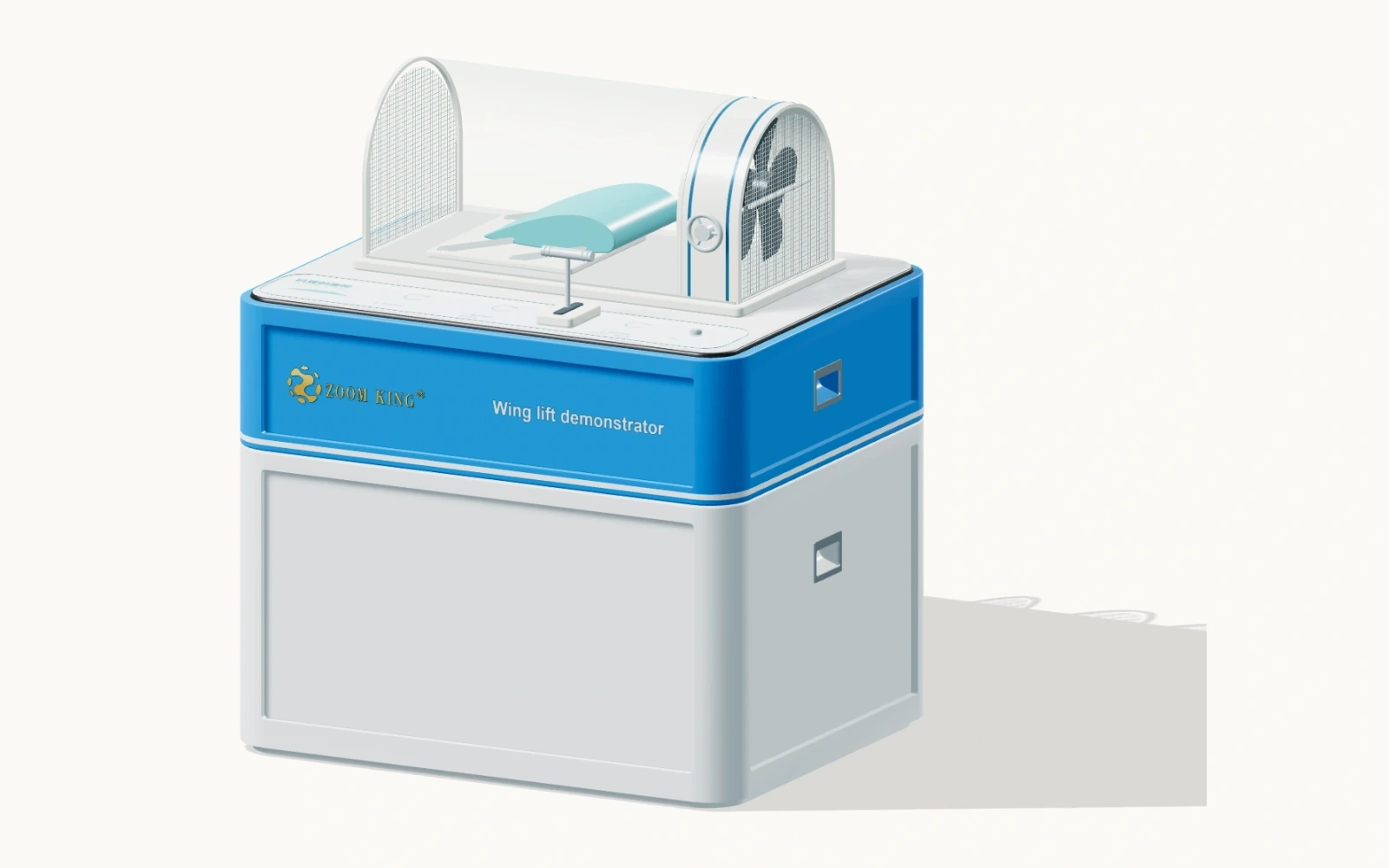
The Wing lift demonstrator workshop video shows a curved wing inside a transparent horizontal enclosure while a visitor uses the front control.
Follow the input
Locate the T-shaped front lever and watch the visitor change its position.
Choose a reference
Compare the wing's position with the fixed enclosure and visible supports.
List missing measurements
Look for an airspeed or force reading before proposing a numerical explanation.
About this video reference
The recording does not establish pressure distribution, calibrated airspeed, wing force, angle of attack or lift coefficient. Control movement alone does not identify which physical quantity it changes.
01 / EXPLAINING THE IDEA
Begin with four forces and relative airflow
Weight is gravity's pull on the aircraft. Lift acts perpendicular to incoming airflow, while drag opposes motion through the air. Propulsion supplies thrust. In ordinary straight, level flight these forces can balance, allowing an airplane to continue moving without accelerating.[3][1]
A wing's important speed is relative to the air, not the ground. A stationary model can experience aerodynamic forces when air moves past it, allowing demonstrations without sending a model across a room. Ask learners to point to the approaching airflow before drawing a lift arrow.[1]
02 / EXPLAINING THE IDEA
Pressure and momentum describe one interaction
Air exerts pressure over both sides of a wing. For a lifting wing, the distribution commonly includes lower pressure above and higher pressure below. Adding the pressure forces over the surface gives a net force. A simple two-arrow sketch is useful, but real pressure varies from place to place rather than having one uniform value above and another below.[3]
Now widen the view to include the surrounding air. The wing changes the airflow's direction, giving air a downward momentum change overall; the air exerts an opposite force on the wing. Both upper and lower surfaces participate. Pressure forces explain how wing and air push on each other, while momentum accounts for the resulting change in motion. Do not add these as two separate lifts.[1]
03 / EXPLAINING THE IDEA
Air parcels do not have an appointment at the trailing edge
A familiar story says air must travel faster over a curved upper surface because it has farther to go and must meet the air traveling below. The meeting requirement is false. Neighboring air parcels that separate near the front need not arrive together at the back. A correct pressure explanation does not depend on this invented timing rule.[2]
NASA illustrates the problem with a symmetric airfoil: its two surface lengths match, yet an appropriate angle to the airflow can generate lift. Shape matters, but upper-path length alone cannot determine the force. Ask learners which observation would challenge the equal-transit story, then distinguish that test from merely repeating the phrase 'faster air, lower pressure.'[2]
04 / EXPLAINING THE IDEA
Angle of attack changes how a wing works
Angle of attack describes the wing's inclination to the incoming airflow. Increasing it often increases lift over a useful range, but the trend does not continue indefinitely. Beyond a critical angle, extensive flow separation reduces lift: the wing stalls. This is an aerodynamic condition, and it does not mean that every aerodynamic force instantly vanishes.[3]
Keep angle relative to airflow separate from angle relative to the floor. Draw two wings at the same page angle with different incoming-flow arrows. Do their angles of attack match? Establish what an exhibit control changes before calling it an angle adjustment. Handle motion is not a measurement.
05 / EXPLAINING THE IDEA
Use the lift equation with its conditions attached
The lift equation organizes several important dependencies. If density, reference area and lift coefficient remain fixed, doubling airspeed gives four times the lift. That is a conditional comparison. On a real aircraft or changing experiment, the lift coefficient can also change with wing geometry, angle of attack and flow conditions.[4]
The coefficient is not a universal number printed invisibly on every wing. It usually requires experimental evidence or an appropriate validated calculation. To estimate it for an exhibit, one would need calibrated force and airflow measurements plus a clearly defined reference area. A short video of a wing changing position does not supply that evidence.[4]
06 / EXPLAINING THE IDEA
Give each flight exhibit a different observation question
Start with the Wing lift demonstrator: what changes relative to its enclosure? In the Propeller lift demonstrator recording, a visitor operates a handwheel and an enclosed propeller rotates. The Flight simulator recording shows a visitor using a yoke and levers while the screen presents a flight activity. Each offers a different observation question.
Give a group three cards: 'visible movement,' 'proposed explanation' and 'measurement needed.' Sort their statements after viewing. A rotating propeller and a moving screen each invite questions, but neither alone measures wing lift. End by identifying evidence that could show an airflow setting increased the force on a wing.
Common questions.
Is lift caused by Bernoulli's principle or Newton's laws?
Pressure differences and momentum changes are compatible parts of the explanation. A complete airflow description must satisfy both; they are not competing forces to add together.[1][2]
Must a wing be more curved on top to generate lift?
No. A symmetric airfoil can generate lift at a suitable angle of attack. A longer upper surface is not a universal requirement.[2]
Can a museum video reveal the wing's lift coefficient?
Not by appearance alone. That requires suitable force, airspeed, density and reference-area evidence, with the wing and flow conditions documented.[4]
SCIENCE & FURTHER READING
Follow the sources.
Read the original scientific explanations and teaching resources behind this article.
- NASA Glenn Research Center: What Is Lift?
Relative airflow, lift direction and momentum change; both wing surfaces contribute to turning the flow.
- NASA Glenn Research Center: Incorrect Lift Theory — Equal Transit Time
Rejects the equal-transit premise while retaining pressure-force reasoning; includes a symmetric-airfoil counterexample.
- NASA Museum in a Box: Principles of Flight in Action, Grades 9–12
Four-force context, angle of attack and stall; apparatus-specific simulation values are not transferred to an exhibit.
- NASA Glenn Research Center: Lift Equation
Lift equation, reference area, coefficient dependencies and need for suitable experimental or mathematical determination.
Editorial: Exhibit Engineers science & exhibit team. Scientific references are cited for the explanations; product configuration details follow the linked exhibit records.