THE SHORT ANSWER
The key idea, first.
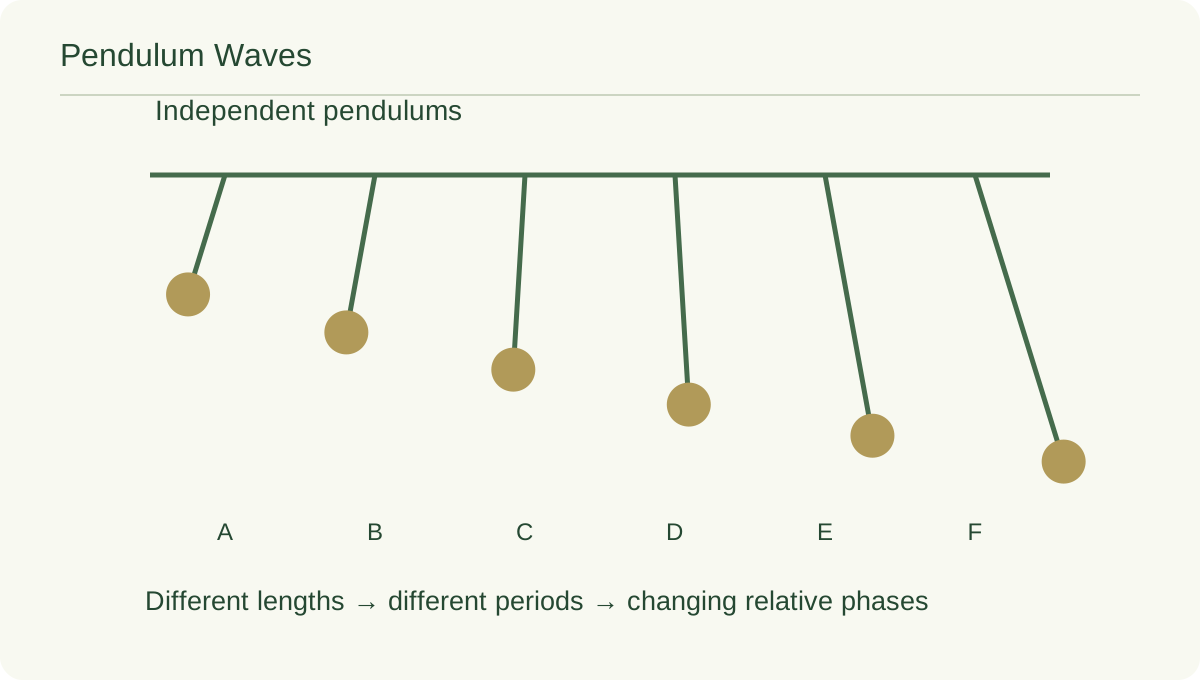
A pendulum wave is an array of separately swinging pendulums with deliberately different periods. Their timing gradually separates, making the row appear to bend and travel. Carefully chosen frequencies can bring them back into alignment. The moving shape comes from changing relative phase; it does not require energy to travel from one pendulum to the next as it does along a connected string.
- Distinguish an individual swing from the changing pattern across an array.
- Explain how pendulum length affects period within the small-angle model.
- Use relative phase and whole-cycle counts to explain possible realignment.
WATCH & NOTICE
Look closely at the demonstration.
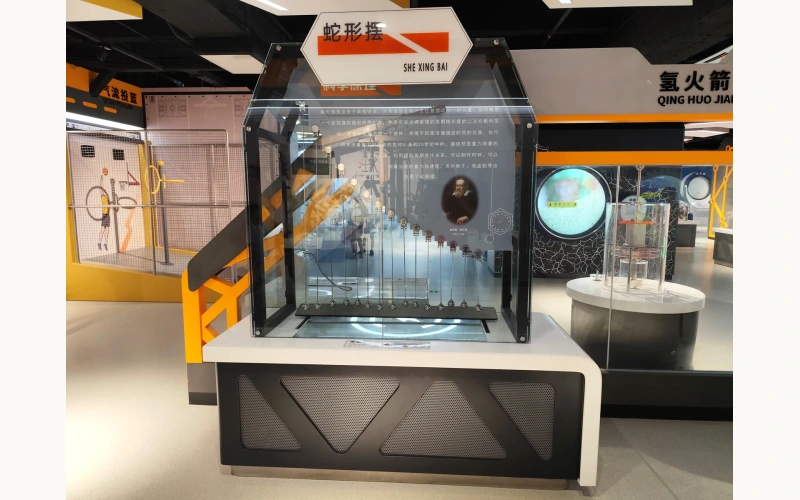
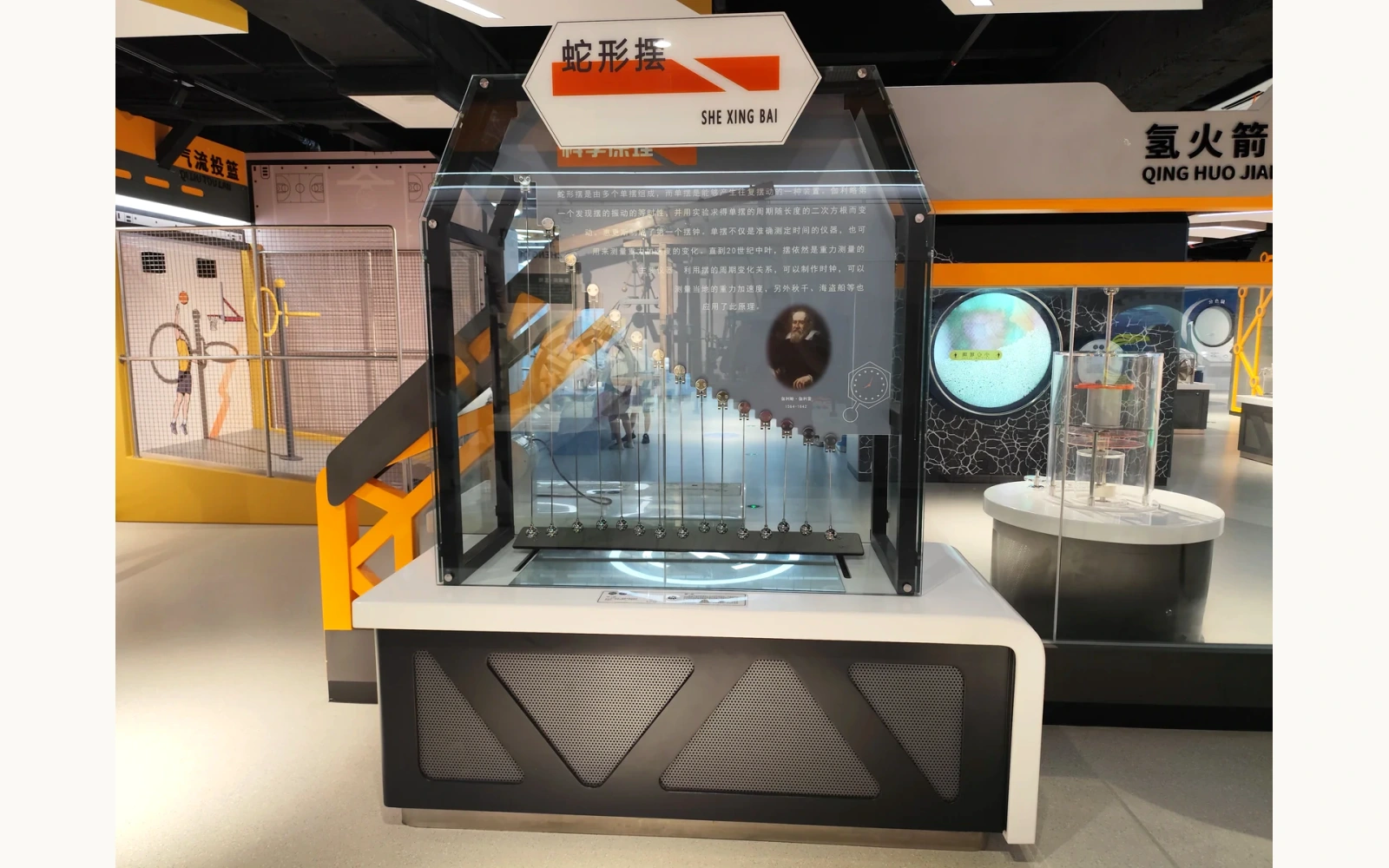
The Pendulum wave museum exhibit recording shows a real cabinet and moving bobs behind its clear enclosure. Watch it once for the overall pattern, then again for one pendulum.
Choose one bob
Follow its back-and-forth path rather than following the changing outline of the row.
Compare neighbors
Look for moments when nearby bobs occupy different parts of their swings.
Widen your view
Compare the changing positions across the array with the repeated motion you tracked individually.
About this video reference
The short recording does not establish each pendulum's period or the array's full recurrence time. Its changing camera angle is also unsuitable for precise displacement measurements.
01 / EXPLAINING THE IDEA
Watch one swing, then the whole row
A changing curve across a pendulum array can look like something moving from one end to the other. Begin with a smaller observation: select a bob and follow it through a complete return to the same position and direction. It swings around its own resting position rather than traveling down the display.
Now let your attention move to the full row. The eye joins the bobs into an imagined line, even though there is no physical line joining them. Ask learners to describe that line with sketches. Keeping the individual motion and the collective shape in separate drawings makes the central puzzle easier to discuss. Compare two sketches from different moments: which details describe a bob's own movement, and which describe a relationship among several bobs? That distinction will guide the explanation.
02 / EXPLAINING THE IDEA
Length sets the rhythm
Period means the time for one complete oscillation. For an ideal simple pendulum, gravity supplies a restoring effect and the suspension fixes the path. A longer pendulum has a longer period, so it completes fewer swings in the same interval. In an array, small length differences can therefore produce small differences in rhythm.[2]
The familiar equation is an approximation for a compact bob on a light suspension making small swings. Mass cancels from this model: doubling the bob's mass does not double its period. Large swing angles, a substantial suspension mass or a widely distributed swinging body require more careful treatment. Measuring an exhibit is different from assuming it perfectly matches the ideal model.[2]
03 / EXPLAINING THE IDEA
Phase describes where each swing has reached
Two bobs can have similar periods yet gradually move out of step. Phase describes progress through a repeating cycle. Pendulums released together may initially reach their turning points together; a slightly faster one then gains a little of a cycle on its neighbor with every swing. A small timing difference becomes conspicuous after many cycles.[1]
Imagine two walkers following separate circular tracks at different steady rates. Neither needs to push the other for their positions to change relative to one another. The same timing idea helps explain the array. Clusters and wave-like shapes are snapshots of many phase relationships, rather than evidence that the individual pendulums have acquired a new kind of motion.[1]
04 / EXPLAINING THE IDEA
Why carefully tuned arrays can realign
A designer can choose frequencies so that every pendulum completes a whole number of cycles within one shared interval. If they begin in phase, that interval brings their idealized motion back into phase. Equal spacing between pendulum lengths is not the same design rule: frequency depends on the inverse square root of length.[3]
For a hypothetical timing exercise, suppose three oscillators complete 12, 13 and 14 cycles in a shared interval. At its end, each has returned to its starting phase, although each has followed a different rhythm. These numbers describe a teaching example, not the supplied exhibit. Harvard's published array uses its own tuning; its bob count and cycle time are not specifications for another apparatus.[3][1]
05 / EXPLAINING THE IDEA
An apparent wave is different from energy transfer
In a wave traveling along a stretched string, neighboring sections interact, allowing a disturbance and energy to move through the material. The ideal pendulum-wave explanation instead treats the pendulums as uncoupled oscillators. Their initial motions evolve at different frequencies. A traveling-looking outline alone is therefore insufficient evidence for energy passing along the array.[1][4]
There is a useful comparison: two pendulums hanging from a flexible shared support can influence each other. In the Exploratorium's coupled-pendulum activity, one initially moving pendulum can set the other moving as their support transmits forces. That is a different experiment. Ask what physical connection would be needed before applying that explanation to a pendulum-wave display.[4]
06 / EXPLAINING THE IDEA
Turn a striking pattern into a small investigation
Give observers different jobs: one follows a selected bob, another compares two neighbors, and a third sketches the array. Then compare accounts of the same viewing. A useful discussion separates what was directly seen, such as different positions, from an explanation, such as different periods. Neither a beautiful shape nor a convincing analogy replaces a timing measurement.
With suitable access and permission to observe a complete run, time several full swings of one bob and divide by the number of swings. Repeat for another bob. Count complete returns, not each pass through the middle. Record the viewing limitations as well as the result; an obstructed view or uncertain count can matter more than another decimal place.[2]
07 / EXPLAINING THE IDEA
Ask what changes when the conditions change
Before a classroom model is altered, ask learners to predict the result of making every pendulum the same length. In the ideal model, equally started pendulums would keep the same phase instead of building the intended shifting pattern. Changing just one length gives a different prediction: one rhythm changes relative to the rest.[2][3]
These questions help a museum discussion move from naming a pattern to explaining it. Finish by asking learners to identify the observation that would test their prediction. For the installed Pendulum wave museum exhibit, keep that investigation observational and use its designated controls; adjustment of internal pendulums belongs to the relevant staff procedure.
Common questions.
Is a pendulum wave a real traveling wave?
It creates traveling-looking patterns, but the ideal array consists of uncoupled pendulums. Its appearance does not demonstrate energy passing between neighboring bobs.[1]
Do heavier bobs swing more slowly?
Bob mass does not set the period in the ideal small-angle simple-pendulum model. Suspension length and gravity do; real construction can introduce additional effects.[2]
SCIENCE & FURTHER READING
Follow the sources.
Read the original scientific explanations and teaching resources behind this article.
- Harvard Natural Sciences Lecture Demonstrations: Pendulum Waves
Uncoupled oscillators, changing relative phases and a deliberately tuned recurrence. Harvard's apparatus-specific numbers are not transferred to Exhibit Engineers.
- OpenStax University Physics: Pendulums
Simple-pendulum period, small-angle assumptions and the distinction from a physical pendulum.
- Exploratorium Science Snack: Pendulum Snake
Direct observation, differing lengths and whole-cycle tuning. Its model dimensions and timing are not exhibit specifications.
- Exploratorium Science Snack: Coupled Resonant Pendulums
A contrasting apparatus in which a flexible support transmits forces and permits energy exchange.
Editorial: Exhibit Engineers science & exhibit team. Scientific references are cited for the explanations; product configuration details follow the linked exhibit records.